Our Philosophy: A Very Good Legal Translation Company in Dubai
Most people who contact a translation office are not looking for a philosophy. They have a document, a deadline, and a place where that document must be submitted. They want to know what it will cost, how long it will take, whether it needs a stamp, and whether someone will answer if a problem appears later.
MOJ License #701 · Khaled Mohamed · Arabic ↔ EnglishOur philosophy begins there.
Arkan Legal Translation exists to make official document work clearer, calmer, and more accountable. We provide MOJ-licensed legal translation, certified translation, and document support in Dubai for ordinary paperwork that can carry serious consequences.
We are not interested in making the work sound more glamorous than it is. We are interested in doing it properly.
Why We Say “Very Good”
Calling ourselves “the best translation company in Dubai” would be easy. It would also tell you very little.
Best at what: price, speed, certificates, court bundles, powers of attorney, or long contracts? Those are different jobs. A serious company should explain what it does well without awarding itself an imaginary trophy.
“Very good” is not a joke and it is not false modesty. It is a practical standard. It means reading the document before pricing it. It means asking where the document will be used. It means giving a realistic timeline instead of the quickest answer. It means putting a name and licence behind certified work. It means correcting our own error without turning the correction into an argument.
We are biased, obviously. It is our company. The evidence should be less biased.
The Document Has a Job
A translation is not finished simply because the sentences sound natural in another language. The translated document has to do something.
A power of attorney must preserve the powers being granted. A contract must keep defined terms, obligations, dates, and references consistent. A certificate may need to match passport records. A court document may have to preserve procedural language exactly.
That is why one of our first questions is simple: where will this document be used?
The answer can affect the language direction, certification, format, stamp sequence, delivery method, and deadline. A document intended for a court is not handled in exactly the same way as one prepared for an employer, embassy, notary, school, bank, or internal company review.
The destination is not an administrative detail. It is part of the translation brief.
Proof Before Adjectives
Arkan's certified Arabic-English legal translation is handled under UAE Ministry of Justice License #701 by a named legal translator, Khaled Mohamed. Where certification is required, the relevant licence details, signature, and stamp appear on the completed translation.
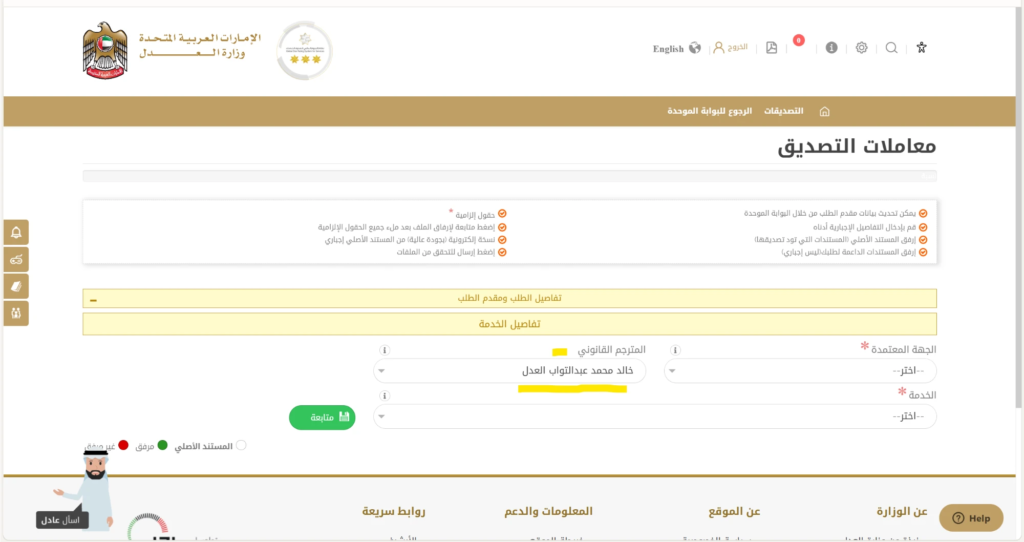
Responsibility should be identifiable. A logo can make a promise; a named professional licence lets the client check who stands behind the document. Our credentials are published on our About page, and the UAE Ministry of Justice provides a public Search for Translators service. The licence does not replace careful work. It establishes responsibility for it.
We Read Before We Price
A rate card cannot see a missing reverse side, a passport-name mismatch, a blurred seal, a handwritten note, or an incomplete stamp sequence.
So we review first.
Before confirming a quote, we look at the document type, language pair, readable content, stamps and seals, names and dates, intended authority, urgency, and required delivery format. When something is unclear, we ask. When a better scan is needed, we say so. When another step may be required before translation, we explain that before work begins.
This is how avoidable problems are caught while they are still small. A few minutes of reading can save days of repetition.
Accuracy Is a Series of Choices
Every translation company says it values accuracy. We prefer to explain what the word means in practice.
Accuracy means not improving, softening, expanding, or simplifying the source merely because a different sentence would sound nicer. It means preserving the legal effect and factual content while writing clearly in the target language. It means treating names, dates, numbers, stamps, seals, handwritten text, defined terms, clause references, and annexes as part of the work rather than decoration around it.
It also means consistency. If a party is called the “Landlord” on page one, that defined term should not become three different expressions by page twenty. If a company's legal name appears repeatedly, it should not drift. If the source is unclear, the translator should not manufacture certainty.
Good legal translation often looks uneventful: the terminology stays stable, the formatting remains usable, and nobody has to ask why the same person, company, or clause acquired a new name halfway through the file. Uneventful is a compliment in this line of work.
The Order Can Matter as Much as the Words
Translation is not always the first step.
Depending on where a document was issued and where it will be submitted, it may need notarisation, authentication, embassy legalisation, MOFA attestation, or another step. Sometimes translation should follow the relevant stamps so the certified version reflects the complete document; sometimes a different sequence applies.
We do not want clients paying twice because the first translation was ordered too early. We also do not want to sell an attestation step that the receiving authority does not require.
Send the document and tell us its destination. We will explain the likely sequence based on the information available, identify anything that needs confirmation, and separate translation work from legal advice or an authority's final decision.
The useful answer is not always “translate now.” Sometimes it is “check this first.”
Good Service Reduces Uncertainty
Official paperwork already creates enough uncertainty. A service provider should remove some of it, not add more.
Before work starts, the client should understand the scope, price, expected timing, certification, and delivery format. If the timeline depends on document length, scan quality, handwriting, specialist terminology, or an external authority, that should be stated. If an urgent deadline is realistic, we confirm it. If it is not, we should not accept payment and hope for a miracle.
Clear communication is not an extra feature. It is part of the work.
After delivery, the client should know whom to contact if a name, format, or authority requirement needs attention. The goal is to help the document reach the next step.
Honesty Includes Boundaries
There are promises we will not make because they would be convenient rather than honest.
We do not guarantee the decision of every court, ministry, embassy, notary, bank, school, employer, or other receiving authority. We prepare the translation for the stated purpose, but the authority controls its own acceptance criteria.
We translate legal documents; we do not replace a lawyer or give legal advice about what a client should sign, file, claim, or concede.
We do not confirm every language or deadline before seeing the material. Outside our core certified Arabic-English work, we check suitable availability first. We do not pretend an unreadable scan is good enough or guess at hidden text. A clear “not yet” or “we need to check” can be better service than an immediate yes.
When Something Needs Correcting
Translation is human work involving documents that may themselves contain inconsistencies, unclear scans, spelling variations, handwritten additions, old templates, and authority-specific requirements. Care reduces errors. It does not make human work magical.
Our responsibility is straightforward:
If a correction is needed because of our mistake, we correct it promptly and at no extra charge. If the source document changes, new information is supplied, or the receiving authority asks for a different format, we explain the required update and confirm any cost before proceeding.
We identify the issue, take responsibility where it belongs, fix the document, and help the client move forward. The goal is not to win a debate. It is to make the file work.
Care Without Theatre
Official documents often contain private family, identity, financial, court, or company information. We ask only for what is needed, handle the material as confidential, and do not turn a client's document into a marketing story without permission.
A certificate may be routine to an office and deeply personal to the person using it. Professional distance should never become indifference.
What This Looks Like on an Ordinary Day
Our philosophy should be visible in ordinary decisions:
- noticing a name mismatch before translating a certificate;
- asking for a missing reverse side;
- explaining that attestation may need to come first;
- keeping a defined term consistent through a long contract;
- refusing an unrealistic deadline before accepting payment;
- correcting our own error without charging for the correction;
- answering the client's question instead of delivering a speech about excellence.
None of these actions is revolutionary. Together, they make a dependable service.
That is the company we want Arkan to be: licensed, useful, candid, careful, and accountable. Not louder than everyone else. Better at explaining what happens next.
Judge Us by What Happens Next
You do not need to agree with every sentence on this page. You do not need to be impressed by a philosophy statement. You need your document handled properly.
Send us a clear copy and tell us where it will be used. We will review it, explain what it appears to need, confirm the scope, price, and timing, and tell you when something should be checked before translation begins.
No theatre. No imaginary awards. Just a document, a destination, and a serious attempt to get the work right.
Send the document and tell us where it will be used. We check the order before you pay.